- Category
- Ads & assets
- What it changes
- Nothing when flagging. When applying, you generate a new responsive search ad, either as an A/B test alongside the old one or as a replacement.
- Reversible
- Yes. With an A/B test, the old ad keeps running; with a replacement, the old one is paused and you can turn it back on. The application is logged in the history with an undo option.
- Data we use
- 30 days: impressions, clicks, CTR and conversions per ad, the ad group's average CTR, Ad Strength, asset labels and the top keywords per group.
- Typical trigger
- An active RSA with at least 200 impressions and 30 clicks whose CTR is more than 20% below the ad group average, without a compensating conversion rate.
- Priority
- High (quality and serving layer).
What it flagsWhat this recommendation flags
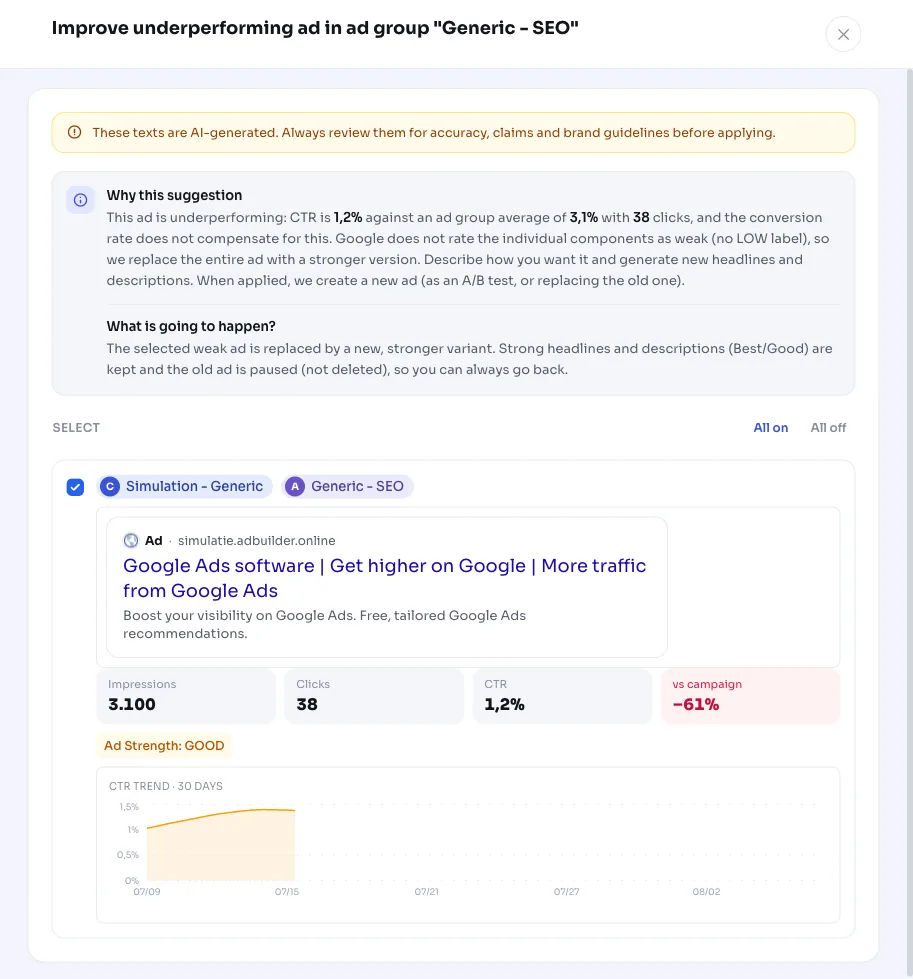
AdBuilder looks at the active responsive search ads per ad group and compares their click-through rate to the weighted average of that same group. An ad that competes on the same keywords but structurally generates fewer clicks is leaving impressions and potential conversions on the table.
The recommendation appears per weak ad, so you get a separate card with the campaign, the ad group, the current headlines and descriptions, and the figures. That way you immediately see which ad it is and why it stands out.
Important to know: the trigger is performance (the CTR), not Ad Strength. Ad Strength (POOR or AVERAGE) is only mentioned as extra context in the explanation, never as a reason on its own. Ad Strength is Google's measure of asset diversity, not a performance metric.
Why it mattersWhy a weak ad costs you money
Ads within an ad group compete for the same keywords. The ad with the lowest CTR wins fewer auctions and attracts less traffic, even though you're still spending impressions on it. A lower CTR also drags down your quality over time, so you end up paying more for the same position.
By improving or replacing the weakest responsive search ad, you shift impressions to copy that performs better. That's usually one of the fastest ways to get more clicks and conversions out of an existing group without extra budget.
How it worksHow AdBuilder identifies a weak RSA
We pull all active responsive search ads over the last 30 days in active ad groups and campaigns. For each ad we calculate the CTR and compare it against the weighted average CTR of its own ad group. We deliberately use the group average rather than the campaign average, because a campaign mixes groups with very different CTR levels and would otherwise systematically flag the wrong half.
An ad only qualifies if there's enough data and the CTR genuinely lags. Being just barely below average, or too little traffic, isn't reason enough to intervene. If an ad converts at or above the group average, we leave it alone: CTR is a means, conversions are the goal.
Ads where Google rates an individual component as weak (an asset labeled LOW) fall outside this recommendation and go to the more targeted asset improvement instead. This recommendation is specifically about ads where no single component is labeled weak, but the ad as a whole still underperforms, and those deserve a completely new ad.
- Lookback window: 30 days.
- At least 200 impressions and 30 clicks, so the CTR is reliable.
- CTR is more than 20% below the ad group average (threshold: 0.8 times the average).
- Conversion safety net: if the ad converts at or above the group average, no recommendation.
- The ad must have a final URL.
- Excluded: ads with a LOW-labeled component and ads in a running A/B test (both the control and the variant ad).
- Up to 5 ads at a time, worst CTR first.
- Dismissible per ad; after applying, the same ad won't reappear for 14 days.
What you can doWhat you can do with the recommendation
When applying, you describe in your own words how the new ad should sound. AdBuilder then generates new headlines and descriptions, which you can fine-tune before pushing them to Google Ads. As a starting point, you get the ad group's top keywords and a CTR chart from the last 30 days, so the new copy connects to what people are actually clicking on.
- Choose A/B test: the new ad runs 50/50 alongside the existing one, so you can compare based on data.
- Or choose replace: the new ad takes over and the old one is paused.
- Edit the generated headlines and descriptions before pushing; nothing is applied automatically.
- Use the included top keywords and CTR chart as guidance for the new copy.
- Have a good reason to keep the ad? Dismiss the recommendation; it won't come back right away.
Frequently asked questions
Why is this particular ad flagged as weak?
Because its CTR over the last 30 days is more than 20% below the average of its own ad group, while there's enough data (at least 200 impressions and 30 clicks) and the conversion rate doesn't make up for it.
Does Ad Strength factor into the decision?
No. The trigger is the click-through rate, not Ad Strength. A POOR or AVERAGE Ad Strength is only mentioned as extra context in the explanation. There's a separate recommendation for improving individual weak components.
How do I improve a weak responsive search ad like this?
When applying, describe how you want the ad to sound. AdBuilder generates new headlines and descriptions that you adjust yourself. Then you choose whether to run it as an A/B test alongside the old one or replace the old one.
Will my old ad be deleted?
No, not deleted. With an A/B test, the old one keeps running. If you choose to replace, the old one is paused and you can turn it back on later. The application is logged in the history with an undo option.
Why do you compare against the ad group average instead of the campaign?
Ads within a group compete for the same keywords; that's the fair comparison. A campaign average mixes groups with very different CTR levels and would flag the wrong ads.
What if an ad has a low CTR but converts well?
Then the recommendation doesn't appear. If the ad converts at or above the group average, it's doing its job and we leave it alone.