- Category
- Ads & assets
- What it changes
- Adds a rewritten ad (RSA) and pauses the old one
- Reversible
- Yes, you can turn the old ad back on
- Data we use
- Quality Score, ad relevance and expected CTR per keyword over 30 days
- Typical trigger
- Quality Score 1 to 4, at least 50 impressions, and ad relevance or expected CTR below average
- Priority
- High: quality layer
What it flagsAn ad group with a low Quality Score
Quality Score is the quality rating (1 to 10) Google assigns per keyword. It's made up of three components: expected CTR, ad relevance and landing page experience. This recommendation looks at keywords with a Quality Score of 1 to 4 where the bottleneck lies in the ad itself: ad relevance or expected CTR is below average.
Those are exactly the two components you can fix with better ad copy. If landing page experience is also below average, the recommendation is extended with tips and a wireframe for the page (see below).
Why it mattersWhy a low Quality Score costs you money
Quality Score influences your ad position and your cost per click. With a low score you often pay more per click for a lower position, or you miss out entirely in competitive auctions. Keywords with a score of 1 to 4 are therefore where more relevant ad copy pays off fastest.
Because this is a quality and policy issue, this recommendation sits in a high priority layer: ad quality is a precondition before it's worth tweaking bids or budget.
How it worksHow AdBuilder detects a low Quality Score
AdBuilder looks at the keywords in your active ad groups over the last 30 days, excluding the most recent 3 days because figures and conversions there are still settling. For each keyword we add up impressions and check the Quality Score and its components.
- Threshold: Quality Score 1 to 4 and at least 50 impressions in that window.
- And: ad relevance or expected CTR is below average (the components you can fix with copy).
- Selection: up to 5 ad groups, chosen by highest impressions.
- The active ad in the group must have at least 3 headlines and 2 descriptions, otherwise we skip it.
- Groups with a running A/B test are excluded, as are groups already getting an ad rewrite from another recommendation.
- If landing page experience is also below average and the page gets at least 100 clicks, you get the combined variant with a landing page wireframe.
What you can doReview and apply the new ad
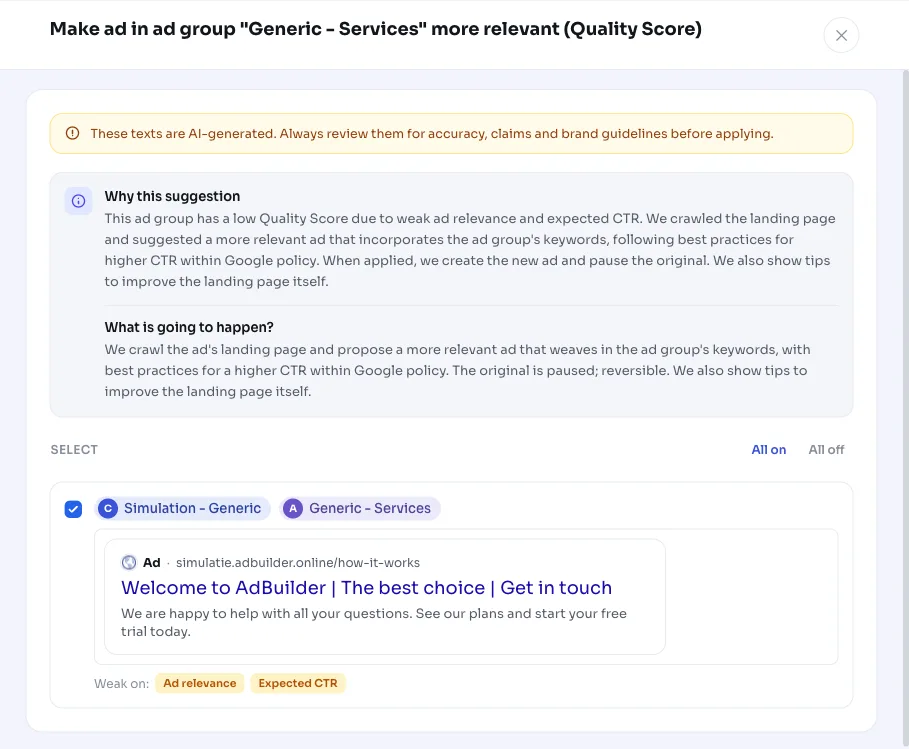
AdBuilder crawls the landing page and, based on it, writes a more relevant, complete responsive search ad. The existing headlines and descriptions are rewritten in place (pinned positions are kept) and the empty slots are filled up to Google's maximum of 15 headlines and 4 descriptions. More relevant assets mean a higher Ad Strength and therefore a better Quality Score. You also get three concrete tips to improve the landing page experience.
- Review the proposed ad and tweak headlines or descriptions yourself if needed.
- Apply: AdBuilder publishes the new ad and pauses the old one.
- You can always undo it: turn the old ad back on.
- With the combined variant, also use the landing page wireframe to make the page more relevant.
Frequently asked questions
What does a low Quality Score in Google Ads mean?
Quality Score is a rating from 1 to 10 per keyword, made up of expected CTR, ad relevance and landing page experience. A score of 1 to 4 counts as low: your ad position drops and you often pay more per click. This recommendation focuses on cases where the ad copy is the bottleneck.
How do I improve ad relevance?
Include the keyword literally in multiple headlines, make sure the copy matches the landing page, and vary the angles (benefit, USP, call to action). AdBuilder does this for you by writing a more relevant, complete RSA that you can still fine-tune before applying it.
Can I improve expected CTR with this recommendation?
Yes. Expected CTR is one of the two components this recommendation targets. Making headlines more relevant and clickable, and adding more strong assets, raises Ad Strength and often expected CTR along with it.
Will my old ad be deleted?
No. When you apply, the old ad is paused, not deleted. You can undo the change by turning the old ad active again.