- Category
- Bids & budget
- What it changes
- Raises the daily budget of converting, budget-constrained search campaigns by up to +50%
- Reversible
- Yes, you can always revert the daily budget
- Data we use
- Impression share lost to budget, conversions, cost and CPA per search campaign over 30 days
- Typical trigger
- At least 10% impression share lost to budget, at least 5 conversions and a CPA around or below the account average
- Priority
- High
What it detectsWhat does limited by budget mean?
A search campaign is limited by budget if it could have been shown more often, but the daily budget runs out before the day ends. Google Ads logs that as impression share lost to budget: the share of possible impressions you're missing purely because there was no budget left, not because your bid or quality fell short.
AdBuilder specifically looks for campaigns where this happens while they're still converting. That's the interesting case: there's demand, the campaign is turning that demand into conversions, and the only thing holding back growth is the budget limit. Campaigns missing impressions because of a low ad position (impression share lost to rank) are deliberately excluded here, since more budget won't fix that.
Why it mattersWhy a too-tight Google Ads budget costs you conversions
If a profitable campaign stalls partway through the day, you're leaving conversions on the table that you could have gotten within your normal cost per conversion. The lost impression share isn't an abstract number then, it's a direct drag on your results.
At the same time, you don't want to blindly pump in budget. More money into a campaign with a too-high CPA makes your results worse, not better. That's why AdBuilder only raises the budget of campaigns that demonstrably run efficiently, so extra budget actually delivers extra conversions instead of extra waste.
How it worksHow AdBuilder identifies budget-constrained campaigns
We look at enabled search campaigns over the last 30 days, with the window ending 3 days back so late conversions are properly counted. Per campaign we weight the impression share lost to budget against the number of impressions and calculate cost, conversions and CPA.
A campaign only qualifies if all conditions are met. If a campaign just misses one of the thresholds, the recommendation deliberately stays quiet rather than raising budget on thin evidence.
If a campaign shares its budget with other campaigns, we make at most one proposal per shared budget: the campaign with the highest lost share counts as the representative, so the same budget isn't raised twice. At most 20 campaigns are proposed at once. Budgets already changed in roughly the last 28 days are skipped, so increases don't stack on top of each other.
- Channel: search campaigns only, status enabled.
- Impression share lost to budget of at least 10%.
- At least 5 conversions in the window (enough evidence for a CPA verdict).
- CPA no higher than 1.2x the account CPA (efficiency requirement).
- The daily budget hasn't already been changed in roughly the last 28 days.
- The budget plan marks the campaign as constrained (not as a candidate for reallocation).
- Suggested increase: +50% or the lost share, whichever is smaller, with a hard ceiling of +50%.
What you can doRaise the daily budget or adjust the proposal
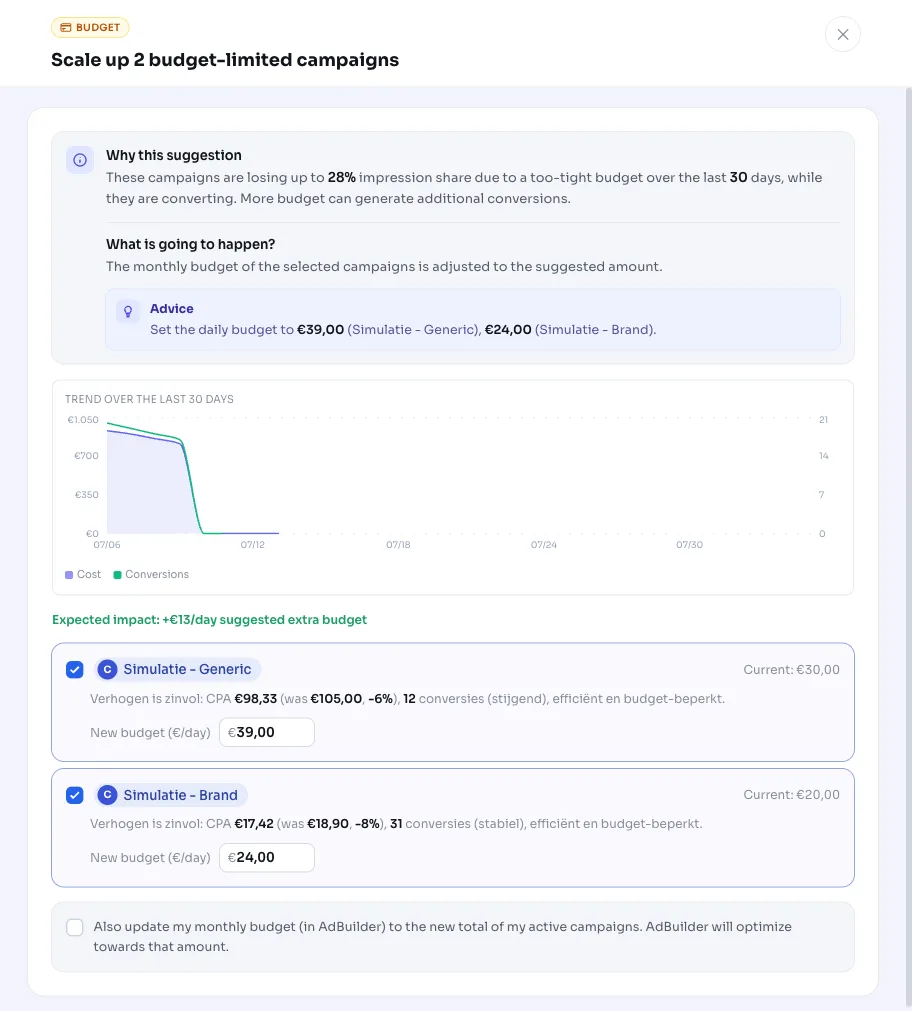
The recommendation shows the current daily budget and the proposed new daily budget per campaign, plus how much impression share was lost to budget. For a campaign losing 22% share, for example, the budget is raised by 22%; if you lose more than 50%, the increase stops at +50%.
Applying raises the daily budget in Google Ads. It's a regular budget change, so you can always revert it to the old amount if the result disappoints. If you'd rather not scale a campaign up, you can dismiss the proposal; it only comes back once the situation meets all conditions again.
If you prefer to work more conservatively or more aggressively, your account's chosen posture also affects how strict the thresholds are: on grow the requirements are looser and the increase can go up to +70%, on cut-waste they're stricter and the increase stays smaller (up to +35%).
- Apply: the daily budget is automatically raised by the suggested step.
- Adjust: choose a different amount yourself before applying.
- Dismiss: the campaign stays on its current budget.
- Revert: manually set the daily budget back to the old value.
Frequently asked questions
What does limited by budget mean in Google Ads?
It means your campaign could have gotten more impressions, but the daily budget ran out. That loss is called impression share lost to budget. Unlike loss from a low ad position, this is one you can actually fix with more budget.
By how much does my daily budget get raised?
By the campaign's lost impression share, up to a maximum of +50%. Lose 15% and the budget goes up 15%; lose 60% and it stops at +50%. On the grow posture that can go up to +70%, on cut-waste up to +35%.
Why don't I get this recommendation for a campaign that's clearly missing budget?
The campaign probably just misses one condition: fewer than 5 conversions, a CPA above 1.2x your account CPA, loss due to rank rather than budget, a budget that's already been adjusted recently, or a shared budget where another campaign is already the representative.
Can I revert the budget increase?
Yes. It's a regular daily budget change, so you can revert the amount back to the old value at any time.
Why doesn't AdBuilder just raise every budget that runs out?
Because more budget only pays off if the campaign converts efficiently. That's why a CPA requirement and a minimum number of conversions apply: pumping budget into an expensive or unproven campaign makes your results worse.