- Category
- Bids & budget
- What it changes
- Lowers the daily budget of selected campaigns by 10% to 40%
- Reversible
- Yes, restore the daily budget with one click
- Data we use
- 30 days of cost, conversions and CPA per search campaign (anchored on T-3)
- Typical trigger
- Campaign spends at least 50 euros with a CPA well above the benchmark and a worsening trend
- Priority
- Critical bucket and account-wide blocker (sort tier 5, budget scaling)
What it detectsSlowing down a wasteful campaign
AdBuilder looks at the last 30 days per search campaign and compares cost per conversion (CPA) to a benchmark. That benchmark is your set target CPA if you have one, otherwise the account average. If CPA is clearly above that and the trend is worsening, the budget plan marks that campaign as 'lower'. This recommendation gathers exactly those campaigns.
Important: this isn't about 'the account going over its monthly budget'. The monthly budget is derived from your Google daily budgets, so by definition you can't exceed it. This recommendation triggers on per-campaign inefficiency, on campaigns spending a lot of money for a poor return, not on exceeding a limit.
Why it mattersWhy a too-expensive campaign costs you money
A campaign spending heavily at a high CPA is pulling budget away from places that would have delivered more. Without intervention, that waste continues every day. By tightening the daily budget on the campaigns that overdo it the most, you structurally curb the waste while leaving your well-performing campaigns untouched.
The reduction is deliberately a budget intervention, not a bid intervention. With Smart Bidding, the strategy ignores a lower keyword bid, so lowering the daily budget is the reliable brake for capping a campaign that's spending too much.
How it worksThe thresholds behind the recommendation
The detector relies entirely on the budget plan and only picks up campaigns meeting all the conditions below. The measurement window is 30 days, anchored on T-3, so that still-lagging conversions don't artificially inflate CPA.
The reduction scales with how far CPA sits above the benchmark: cut = min(40%, max(10%, overage)). In practice that's always between 10% and 40% of the daily budget, with a hard ceiling of 40%.
- Only search campaigns with plan verdict 'lower': inefficient (CPA above benchmark) and a worsening trend, with enough measurement certainty (at least 5 conversions, or sufficient cost with a ROAS benchmark).
- At least 50 euros of cost in the window: without material spend, a reduction can't be justified.
- A dedicated, non-shared daily budget greater than 0. Shared budgets are skipped, since a reduction would also hit the efficient campaigns on that same budget.
- Margin gate: CPA must be at least 10% above your target CPA, or at least 20% above the account average if you haven't set a target.
- Budget cooldown: campaigns whose budget has already changed in the last 30 days are skipped (otherwise reductions would stack). If that check fails, we lower nothing out of caution.
- There must be conversion tracking (conversion gate), and at most 20 campaigns are proposed at once, sorted by cost.
What you can doApply or revert the proposal
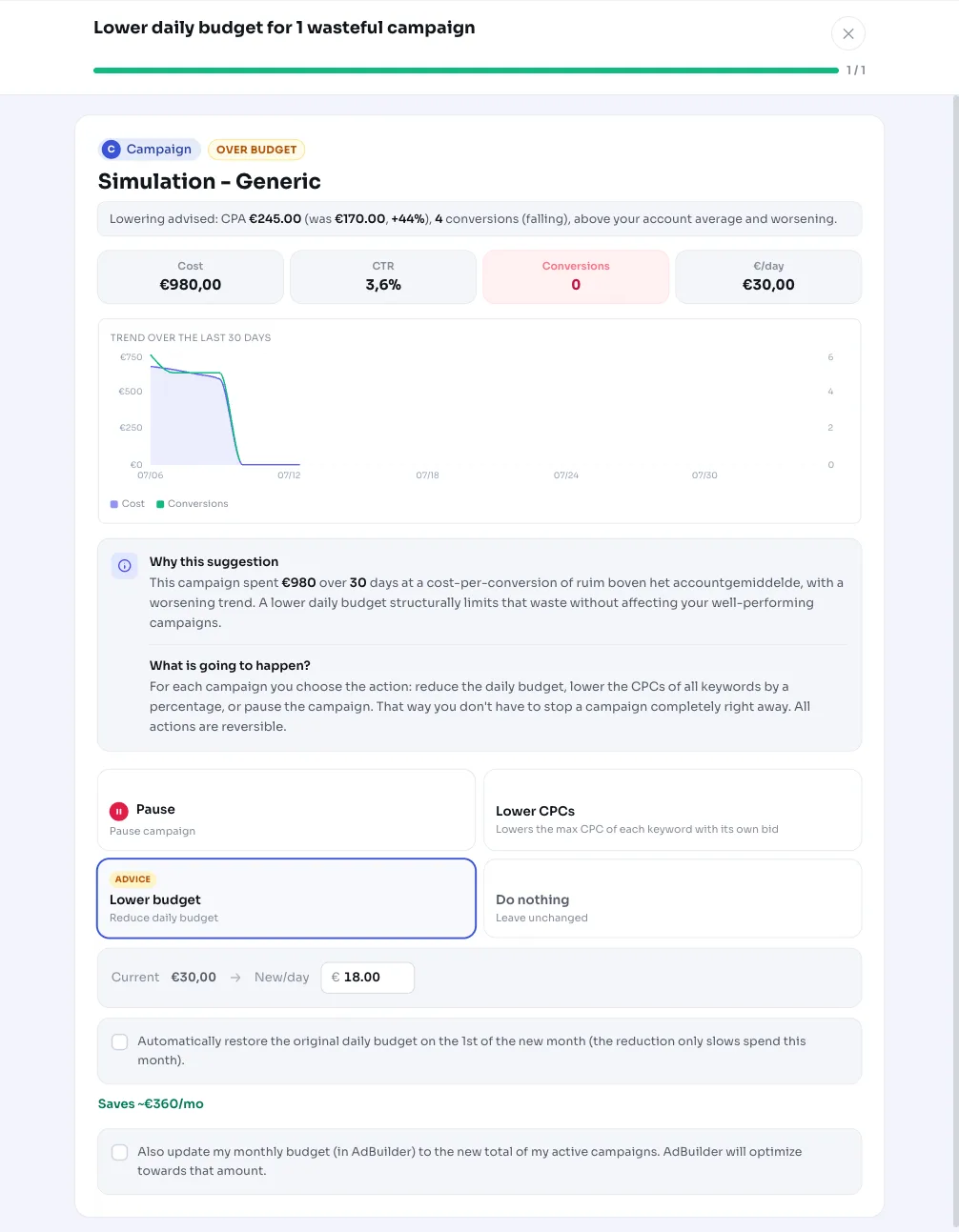
Per campaign you see the current daily budget and the proposed lower daily budget. If you apply the recommendation, AdBuilder lowers the daily budget in Google Ads to that proposed amount. The recommendation also shows how much waste you're cutting per day combined.
- Apply: the daily budget of the proposed campaigns drops to the calculated amount (10% to 40% lower).
- Reversible: if you don't like the result, restore the daily budget to the old value just as easily.
- Dismiss: if you think the campaign is worth it, dismiss the recommendation and the budget stays unchanged.
- With Smart Bidding, also consider whether your target CPA or target ROAS is realistic; a structurally too-tight target could be the cause.
Frequently asked questions
What does it mean that a campaign is spending too much?
Here it means a search campaign has spent at least 50 euros in 30 days at a cost per conversion well above your target CPA or the account average, with a worsening trend. So it's about poor return, not an exceeded limit.
How do I lower a campaign's budget?
AdBuilder calculates a lower daily budget per campaign (10% to 40% less, depending on how far CPA sits above the benchmark). You apply the recommendation and the new daily budget is set in Google Ads. You can always revert it.
Does this affect my well-performing campaigns?
No. Only campaigns with their own budget whose CPA is clearly above the benchmark and worsening qualify. Efficient campaigns and campaigns on a shared budget are left untouched.
Can I revert the reduction?
Yes, the intervention is reversible. Restore the daily budget to the old value with one click if you change your mind.
Why lower the budget and not the bid?
With Smart Bidding, the strategy ignores a lower keyword bid, so that wouldn't curb spend. Lowering the daily budget is the reliable way to cap a too-expensive campaign without giving up on conversions entirely.