- Category
- Targeting & structure
- What it changes
- Widens the bid strategy target where it pays off, replaces weak ad assets, and suggests a better landing page
- Reversible
- Yes. Bid and target changes can be rolled back, and the old ad is paused, not deleted
- Data we use
- Impression share lost to rank, impressions and cost, plus Quality Score components (ad relevance, expected CTR, landing page experience)
- Typical trigger
- Search campaign losing at least 20% impression share to rank, with at least 500 impressions or €50 in cost within the window
- Priority
- Bidding layer: after waste cleanup and quality, before budget scaling
What it flagsWhat does impressions lost to rank mean?
Google reports per search campaign how much of your potential impressions you missed, and why. There are two causes: impressions lost to budget (your daily budget ran out) or impressions lost to rank (your ad ranked too low in the auction to show). This recommendation looks only at the latter: the share you're losing due to position, measured via search_rank_lost_impression_share.
Impression share lost to rank means there was demand and your ad was eligible, but competitors outranked you in the auction. That's caused by a bid that's too low, a lower Quality Score, or a combination of both. Unlike lost budget share, throwing more money at this won't fix it: you need to come out of the auction stronger.
Why it mattersWhy rank loss costs you reach
Every percentage point of impression share you lose to rank is reach you're missing on search terms you chose yourself. This isn't random traffic, it's auctions you actually took part in and lost. On campaigns that otherwise convert well, this is often the cheapest growth available: you don't need to think up new keywords, you just need to win more often.
Because the recommendation explicitly excludes budget loss, you know that more budget won't help here. The fix is in bid or quality. That's why AdBuilder ties the signal directly to concrete levers instead of showing it as a standalone alert.
How it worksHow AdBuilder detects rank loss
AdBuilder aggregates the impression share lost to rank per search campaign over a 30-day window ending T-3 (the last 3 days are skipped since that data isn't complete yet). On smaller accounts, a longer, volume-dependent window (60 or 90 days) may be used, since impression share is more stable and less noisy there over a longer period.
The loss is weighted by the estimated number of biddable auctions per day (impressions divided by impression share), not by raw impressions. That way, days where you only captured a small share don't count too lightly. Days without a valid impression share contribute nothing to the weighting.
- Only search campaigns with status enabled count.
- Volume floor: a campaign only counts once it has at least 500 impressions or at least €50 in cost within the window (otherwise it's noise on tiny campaigns).
- Threshold: the weighted share of impressions lost to rank is at least 20%.
- Up to 6 campaigns are flagged, sorted by the highest rank loss.
- A campaign is only shown if there's at least one usable lever attached; without an action, the recommendation doesn't appear.
What you can doWhat you can do about lost impression share
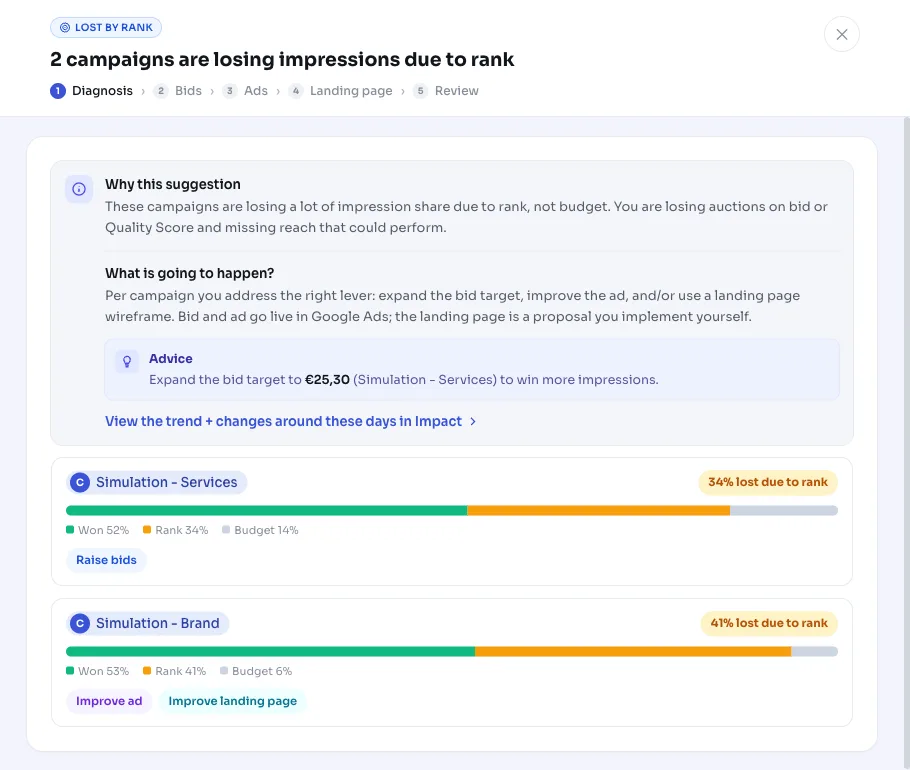
For each campaign, AdBuilder determines which levers make sense and offers them in a wizard. You choose what to apply. The three routes are:
- Widen bid target: for a Smart Bidding target that's running efficiently, the target is widened slightly so you win more often. This only happens with working conversion tracking, at least 10 conversions, and if the campaign is performing within target: Target CPA then goes up by 15%, or Target ROAS down by 10%. Campaigns in the learning phase (target changed in the last 14 days) are left untouched.
- Improve the ad: if ad relevance or expected CTR is below average according to Google, AdBuilder replaces the components Google explicitly marks as weak (LOW label) with stronger headlines and descriptions. Unrated components are left as is.
- Improve the landing page: if landing page experience is below average, you get a suggestion for a better page (wireframe) based on the destination URL and its related keywords.
- The bid route relies on conversion data; the ad and landing page routes are Google's quality judgments and remain available even without conversion tracking.
Frequently asked questions
What is lost impression share?
Lost impression share is the portion of potential impressions you're missing on search terms you advertise on. Google splits this into loss due to budget and loss due to rank. This recommendation looks only at loss due to rank: auctions you took part in but ranked too low to show.
What's the difference between impressions lost to rank and to budget?
Lost to budget means your ads stopped showing because the daily budget ran out. Lost to rank means your ad could have shown but was outranked in the auction, usually due to a bid that's too low or a lower Quality Score. This recommendation is only about rank; more budget won't fix that.
How much rank loss is needed before the recommendation appears?
The weighted impression share lost to rank needs to be at least 20%. The campaign also needs enough volume: at least 500 impressions or at least €50 in cost within the analysis window. Without that, the recommendation stays silent.
Will my bid be raised automatically?
Only if you choose to in the wizard, and only if the conditions are met: working conversion tracking, at least 10 conversions, and a campaign performing within target. Target CPA then rises by 15%, or Target ROAS drops by 10%. Without reliable conversion tracking, AdBuilder only offers the ad and landing page improvements.
Does this also apply to Display or Performance Max campaigns?
No. This recommendation only works on search campaigns, since impression share lost to rank is only reported there. For Display or Performance Max, this signal doesn't apply.
Can I undo the change?
Yes. A bid or target adjustment can be reverted to its old value, and if an improved ad is created, the old ad is paused rather than deleted, so you can restore it. The landing page suggestion is a proposal you publish yourself.